PREAMBLE: HOW DO WE REVIEW A SETTING?
Setting books, in my opinion, occupy an odd space within the sphere of tabletop role-playing games1 of any sort. Most of the time, they tend to be used more as coagulant pot of ideas a GM will dip his spoon in from time to time and season his own campaign with, be that in the form of monsters, items, mechanics or the one or other dungeon, ripped straight out of its original context and more or less melded into a new paradigm. Rarely, if ever, do I hear of people playing in another designer’s world SAW2.. It’s natural, I think. We change things around to fit our table and tastes. And, within the greater scale of the community, most GMs will readily create and carve out their own setting for and at their table. The few exceptions are those settings and worlds that have been around for since practically forever (your Greyhawks, your Forgotten Realms, your Ravenlofts, we all know ‘em) and managed to establish enough of an identity3
As such, the actual reviewing of a setting book presents a slightly more difficult venue than ‘merely’ reviewing an adventure: we are not only looking at room keys (and their frustrating emptiness at times), balance of encounters (which we all know to be more art than science), presence of treasure (I’d love to hear why there is a +3 greatsword lying bare for all in the open of a 1st-level dungeon’s port-a-potty), potential puzzles (start out with puzzles suitable for a 3 year old in terms of complexity and slowly work your way up), or linearity vs. the illusion of player choice, but also on:
Originality & Vibes. What is the fantasy sold here? Is there something that makes it stand out, or are we just looking at Lord of the Rings or Forgotten Realms with the serial numbers all filed off? What Art we got? It better be human-made, or I’ll infest your walls.
Shadowdark RPG Core Ethos. Does it adhere to standardized DCs, layout of monster stats, treasures and talent rolls? Does it keep to the rule of “No Darkvision, period”? If you got classes, do they sell their fiction and are designed not to outshine the Core Four? Do you respect the torch timer?
Overall Gameable & Interactive Content. What options and tools are provided for a GM to facilitate dynamics and adventures in the world? Do we have factions to join or oppose? Do we have adventure hooks? What conflicts exist in the world and its locations to draw on?
Information. How well is the above informed to the GM that is on the fence of running this whole thing for their table? Does the layout add or detract from it?
So, keeping these points in mind, I invite you now to embark on a journey with me, as I go chapter by chapter through Formoria: The Dark Ages. Get something to drink. We’ll be here a bit.
FORMORIA: THE DARK AGES - OVERVIEW
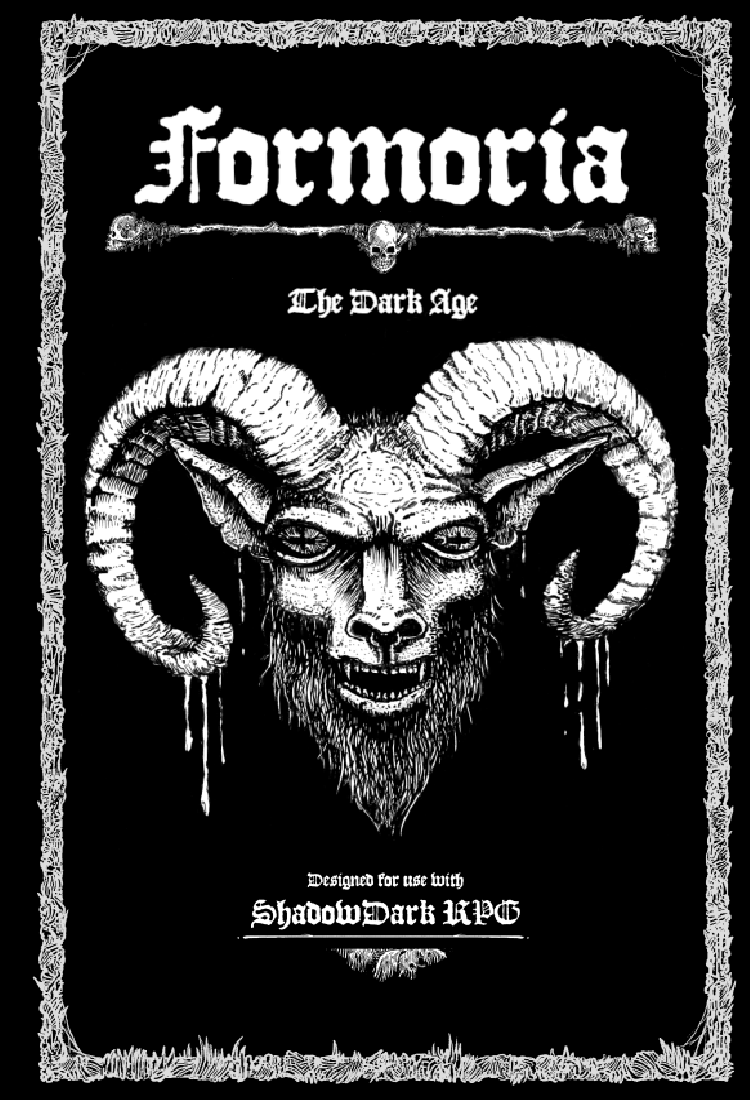
Formoria: The Dark Age by Rune & Relic Press presents itself as a 261 page long setting book for Shadowdark RPG, detailing the titular region of Formoria, explicitly inspired by the 4th century of Europe. The book has the added caveat of being the setting of author Bryan O’Doherty’s home game, claiming over 20 years of continuous development through play.
The overall layout follows the standard of most Shadowdark RPG 3rd-party products, i.e. aping the official layout and look of the Core Rulebook as close as possible: A5 format, black & white colour, double column spread, black bar headers (with some of that rough fringing to make sure you are always aware we’re playing a gritty game). It doesn’t attempt to do anything revolutionary and frankly, I do not expect most authors to do so. The layout of SD is well-known enough at this point and it serves to enhance both easy accessibility and the characteristic, terse but evocative writing style Kelsey went for.
Replicating this effectively, however, is another thing entirely.
PART I: MAP & INTRODUCTION
We are greeted with a double-spread map of the region of Formoria and its adjacent realms. It is a gloriously detailed piece of work, where the only issue I’d find is a slight difficulty in making out some of the place names, as the lettering sometimes meld with the background line work, and some locations are so tightly bunched together that their names are rubbing syllables with another. It’s a minor gripe however, and the detail at hand cannot be understated.
We’re given a quick overview of the fiction this setting is supposed to sell to both players and GM, which I do appreciate:
So, we are immediately given the New Frontier fantasy, burgeoning points of law and order trying to rise in a chaotic, unknown wild. Its a standard fantasy role-playing trope and rife for conflicts, hooks and potential faction-play and I’ve not much to say about it otherwise.
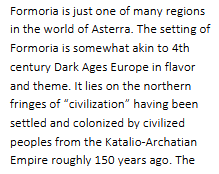
On the following pages, we are given a little more information on what to expect when running a campaign for Formoria, and they fall in line with most of what I expect of a Dark Fantasy setting; make it gritty, make magic feel rare and dangerous, make it grim, but have that little kernel of hope and warmth so your players have something worth fighting for4. We get our first unique spin on the Shadowdark Core Rules through unique death timer rules:
Let the fates decide and A death worthy of song! gives the dying character the choice to either follow normal death timer procedures, or forego it in favour of an immediate, critically successful action that may sway the course of the encounter. It’s swingy, it’s easily implemented and it has a properly heroic fantasy feel to it.
PART II: PLAYER OPTIONS: FROM CLASS TO COIN
Formoria is a human-centric setting and thus, makes use of the Basic D&D approach to demi-humans, specifically, Dwarves, Elves, Halflings and Gnomes being classes of their own. In addition to the Core Four classes, humans further get to choose between Knight, Ranger, Seer, Druid and Warlock, with some classes being restricted to certain alignments and religions. They are fairly inoffensive as far as I can tell, if far more niche than might be good for them:
The Knight class, for example, is entirely combat focused, with a bonus for mounted combat and bonus to hit for selected weapons for horse-riding, but comes off worse than the standard Fighter, whose Grit and Weapon Mastery will just allow him to survive and work through combat encounters much better. This class would expect you to mainly do warfare and taking on enemies on horseback - so you better have dungeons planned that are barrier-free for horses, or this noble knight will get mighty cranky at most of his tool set being inevitably diminished.
The Knight, and most of the Human classes, does however receive a social talent that always grants them ADV on Reaction checks with a specific social class of Formoria. It is a neat idea on paper, but I would’ve perhaps relegated this more to be a background talent, rather than bake it into a class. But, its presence implies a good deal of social roleplay is to be expected within this setting - and I do like me some political intrigue.
The poor ranger gets the short end of the stick, as usual. He can can forage food for the party and do a bit of weather-spotting and navigate the wilds. Otherwise, all of his talents are geared toward making him another poor man’s Fighter. I know it is the Aragorn-Fantasy, but my man Elessar, Heir of Isildur, was a healer and linguist, too, not just a wacky bushman5.
Formoria also introduces us to the Ambition of Men trait, which is, pardon my french, bonkers:

Now, you can make the argument that my reaction to this is blown out of proportion. Most tables are skewed chance-wise for your dice to land more often than not on a simple stat-improvement, with the "cool shit" lurking at the higher and lower fringes of the 2d6 range. But humans already get a bonus talent roll at LV 1, so with a total of three talents at LV 1, that infamous “Shadowdark fragility” often espoused on the wider web may no longer apply. This was likely done to put any human adventurer in line with the demi-human classes, who are, on average, positively bloated with talents.
Let’s talk about those, shall we?
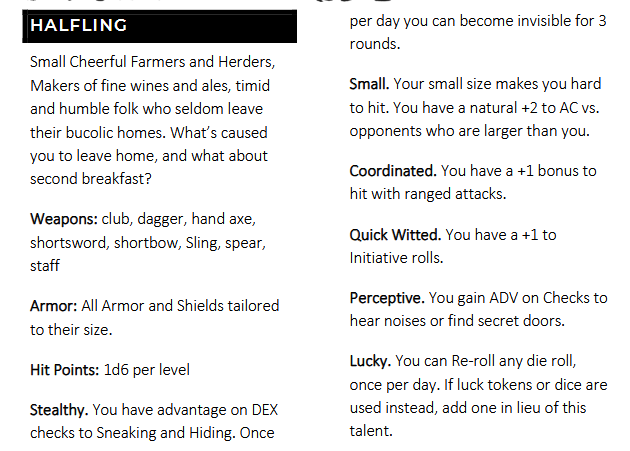
Halflings should be ruling this world and I am not even kidding. ADV on Sneaking and Hiding and invisibility each day for 3 rounds? Along with a lucky talent roll that grants you another use of that ability per day? Natural AC bonus against practically anything that isn’t the size of an average eight year old? Senses that let you easily out-wit the common Shadowdark Thief? The ability to reroll any die roll, not just the d20, and, as written, from anyone around the table?
Move the fuck over elves, this domain now belongs to the Glorious Halfling’s Working Commune.
Most of the demi-human classes occupy a really odd space, mixing basically two or three classes into one, and all coming with some form of ability to detect secret doors and passages, but ultimately coming out worse the wear. Dwarves are a poor man’s fighter mixed with a tunnel-based ranger, Gnomes get some tinkering and a chance at a random Tier 1-3 Wizard spell.
Elves, as per usual, seemingly get the best of it all, what with being only slightly worse spellcasters than wizards, with no access to Tier 5 spells, while also combining the Ranger’s wilderness aptitude and the general combat-bonuses that every demi-human class seems to receive with stacking +1 bonuses to attack rolls or spellcasting on additional talent rolls.
Its an old D&D principle that I could never really get behind being implemented into Shadowdark, to be honest, and they do not quite gel with me here, either. It may ultimately be personal taste, but aside from the juggernaut of the Halfling, I don’t exactly see any of the demi-humans classes standing out compared to the Core Four. Beside some exploration bonuses, there isn’t exactly a new niche covered by them.
The next couple of pages are dedicated to Backgrounds, Names and Languages and I gotta give props to the author for going the distance. Each class has its own dedicated background table, each ancestry has its table of names, and the languages actually have different dialects, as well as rules for literacy, which I do highly appreciate for making languages and issues of communicating across cultures in-game actually a lot more tricky than simple standard Common, Elvish and Dwarvish. It might not be everyone’s cup o’tea, but I always enjoy seeing it.
We are also introduced to an alternate, more “realistic” currency system than the standard Copper, Silver and Gold pieces, which I am also always a fan of, but have to note there is no table or other hint to explain how this alternate currency changes, or rather, is applied to Shadowdark’s XP-through-Treasure rules. A point is made that a simple longsword, worth 9 gold pieces, would be roughly the equivalent of 1,600 US Dollars. Cool. Does that mean that finding a single longsword already rewards you with 1 XP? I can’t exactly assume so, seeing as there is no mention of any changes to character generation when it comes to coinage, and the prices for the new weapons and armour are listed in gp as well, though the same pages goes out of its way to say that Plate Mail is exceedingly rare, Greatswords and Bastard Swords masterworks, and the new scale and brigandine armour rated as the “best armor a regular soldier can hope to get”. A setting-specific table or page addressing Treasure Quality and XP would have been helpful to shed any ambiguity here.
On a side note, the artwork in this book is quite lovely. None of it feels out of place, and serves to enhance the gritty feeling Formoria hopes to invoke.
The book also introduces a variety of new spells for seers and warlocks and most of them are simply ported from D&D. Speak with Animals, Read & Comprehend Languages, Faerie Fire, the gang’s all here and largely made to fit the Shadowdark paradigm, though several of them break across the pages repeatedly.
Most notably, Formoria introduces a new alignment system:
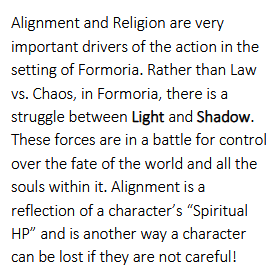
Exciting! I like it when there is some consequence and something such as spiritual decay afflicting a character as a result of slipping into Shadow is a neat idea! We even get a small Alignment Tracking Bar to use! There is detail on how the GM is to award a group points for Shadow and Light actions, and how adventurers may feel the pull of Shadow as they adventure in the wilds! There is even mention of Good Works, Tithings and Prayers to be done to shift your character away from the Shadow’s grasp! I cannot tell you what happens if they fall to it!
No, I literally cannot tell you. The book straight up does not state what happens if your character falls to the Shadow. For all its talk of corruption and spiritual decay and the mark the Shadow may leave on the party, there is nothing in the way of actual consequence. Not even if your character is removed from play. Meanwhile, there is a double page dedicated entirely to doing prayer and committing holy abstinence, spreading your wealth and helping the community and being an all around certified good boy in order to gain Light points, rewards and allies, similar to the carousing table.
I feel robbed. Only natural when interacting with most churches, I suppose, but more importantly, I feel robbed of danger and dread. There is not even any greater benefit for fully indulging in Shadow, like some dark god’s favour or a magic item only working for Shadow aligned beings.
PART III: FORMORIA - 20 YEARS OF WELL-WORN TROPES
We now arrive at the bulk of the book, detailing the realms and, above all, the history of Formoria. And I do mean, above all: the majority of what you receive here is a detailed history of the setting, its glorious and ancient past, the origins of the smaller and greater locations.
On paper, this is exactly what you’d like out of a setting book, right? You buy it for the pre-written background, the more the better. However, the book’s focus on that long, arduous history of its setting comes at the severe penalty of actual game-able content and thus, also serves as one of my major points of critique for this book.
Now, let me get some of the positive stuff out of the way: most locations presented here come with a fairly generous amount of backstory, described aesthetic and cultural tidbits. There is a definite bias for humans and elves6, while my boys, the dwarves, get absurdly little – despite being described as just as massively influential as the elves of the setting. But for every double-column spread of history and markings, I am left with a dearth of conflict. Allow me to show an example:
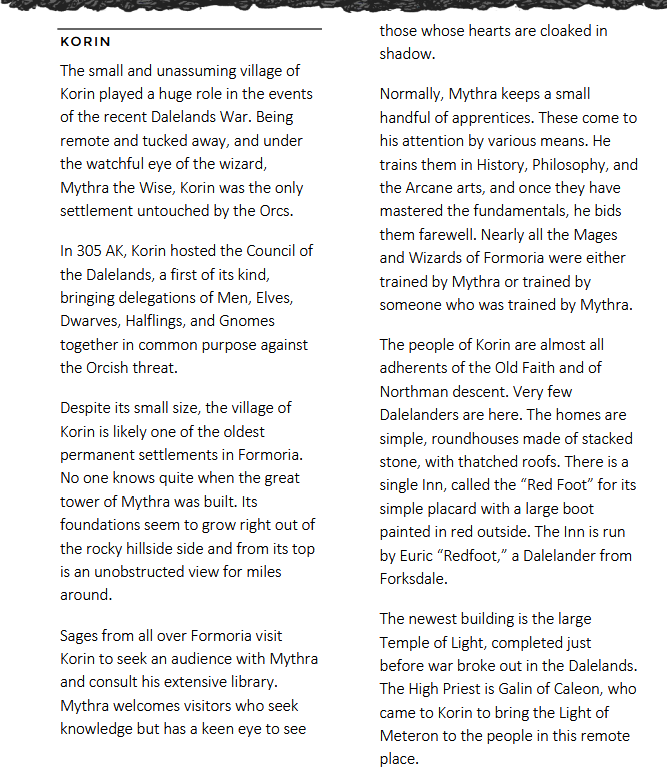
The village of Korin is extensively detailed and its importance in the greater history of Formoria is emphasized above all else. A little odd that this place remains just an unassuming village when it was witness to a council of national importance and hosts, what I can only assume, to be the most powerful wizard in all of Formoria⁸, but hey, if Gandalf liked to relax, smoke weed and pop off fireworks in the Shire, who am I to judge Mythra?
Poor Euric needs some more creative marketing though. Man's defining himself entirely by the Dalelander stereotype of descent by boat-travelling Northmen. You just know he's rolling his eyes every time somebody approaches and asks him if he'd ever been to Byrth.
We also receive a lovingly detailed little map that also brings attention to such locales like “The Spider Wall” or “The Standing Stones” - evocative names that suggest greater mystery, danger even.
Now, you might be wondering, what mysteries do these locations hide? What conflict grips Korin? What issues does the town face that the adventurers could potentially address, dabble in or escalate due to their naturally destructive tendencies?
I dunno. It doesn’t say. History lesson is over, pack it up, move on to the next town location.
Are there any dungeons near? Could be, but could as well not. Okay, are there any bandits roaming this region? Haven’t the foggiest. Are there actually any spiders near the spider wall??? My answer might surprise you, but I dunno.
This is a repeat issue that I struggle with as I flip from one location to the next. If you are lucky, you might find a small sentence squeezed somewhere that mentions that there is usually some conflict with some pirates or raiders from another city over, or a vague evil that supposedly lurks outside the city borders. Some villages are mentioned to have weathered past assaults by orcs and beastmen as their sole point of identity that isn't tied to some fief or river. Cool. So, like basically everyone else in this setting.
There aren’t any NPC profiles, no adventure hooks. In fact, for the former, you have to flip a 100 pages over in order to just get a glimpse at the current lords and ladies of the various regions - notably, those of the present being presented after figures of legend and myth, who are also given much more prominence and detail.
Notably, also, the Orcs and Bhaalspawn are not given any unique locations or cities, or some such, despite sharing this part of the book with the explicit realms of humans and demi-humans, and must make do with being just general bands of marauders and barbarians.
There is a dissonance when it comes to what information receives priority in this book that repeatedly turns its head to mock me.
If you are expecting much of a unique take on Humans, Elves, Dwarves, Halflings and the like, however, you’ll be disappointed. Humans come in the flavours of naked screaming Northmen warrior in tune with the woods and using dire-wolf pets, and a somewhat burgeoning feudal monarchy of the Dalelands.
There is not much more that I can say about them aside from that the Elves sure be Elving, the Dwarves are Dwarfing and the Halflings do what Halflings have always done, namely, chasing second-breakfast and living in rural communities. Imagine the stereotypical, standard elf as presented in any general fantasy setting, and that is the elf you are getting in Formoria. Dwarves are isolated, cranky, but honourable and live in the mountains. You get the idea. This also includes all the usual baggage that older editions of our favourite role-playing games carried with them, such as the factor that the drow in Formoria are literally cursed with blackface as a sign of their ancestral deceit and treachery, marking them as outcast from the rest of the elven population, with the added stickler that they may be freed from this curse and become “indistinguishable from a normal Elf” by rejecting the teachings of their kind. The only way I could read this, was to mean that they somehow lose their drow skin hue if they turn to the Light.
Yes, the book bends over backwards immediately after to assure us that most drow are only "taught" to be evil and not naturally so, but, come the fuck on.
Same goes for the orcs, who are a gaggle of seemingly entirely sentient, but thoroughly evil, destructive and war-hungry species who, say with with me now, dwelt in the East of the civilised world in a barren plain, i.e. a desert, where they served an evil god under a literal volcano and are currently mostly busy with tribal warfare and infighting. No word about any sort of dark tower yet. They value strength and the ability to kill good and plenty, and their evil god also enacted selective breeding programs to create more specialised strains of them to suit his purposes¹º. They are also rather wasteful of their offspring:
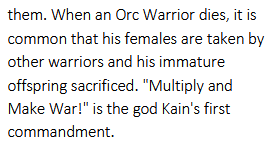
No wonder there are more orc women than men then, if they keep dying young. There is mention made of some of the human realms employing orcs as mercenaries exactly twice in the book, and the figure of Ja’Keel is presented as the one honourable orc amongst the rest, i.e. the walking definition of the Noble Savage who is guiding his brethren and cousins away from plundering the fertile west and relegate them to the barren eastern wastes, but that is the extent of any interaction between these ancestries that did not involve some form of violence.
Lastly, the Bhaalspawn occupy beastfolk, i.e. minotaurs, goatmen and the like, standard goblins and giants. I am not going to go into any further detail, because the same rules apply here as with the demi-humans before: imagine a goblin. Imagine a hill giant. Whatever standard tropes you can think of for them apply here. Frost and fire giants are said to be as rare as dragons, and that’s it. Beastmen, however, actually have a seemingly functional society!
Do not get your hopes up, however, it functions as according to the principles of every fantasy barbarian culture ever made, i. e.: I am bigger and stronger than you, therefor I am better.
There is mention made, however, that the lower caste of the Beastmen, the Mythos, are actually sailors, merchants, administrators and navigators, as opposed to the guards and warriors the other Beastfolk embody. You'd think that sort of advanced knowledge and thinking would make them natural leaders and diplomats, but, nope¹¹.
Time to dabble into a bit of Edward Said's Orientalism. I recognise, the book and setting are attempting to go the route of orcs and beastmen and so on as creatures of inherent evil, demonic even, with little to no moral ambiguity to them at all. The authorial intent is pretty clear here. But, metaphorically, the Author is dead and when you have a highly Middle-European inspired realm being beset by dark, barbaric hordes from the south and east, respectively, very specific imagery is kind of impossible to avoid. Vaadmoor, the big evil necromancy kingdom gets a token mention of "its people being at last freed of their evil master", yet their entire culture, mentioned so far, is steeped in the "dark art of necromancy" and the worship of Gorgache who is not a Hades-type of cthonic deity, but rather of the "I-hate-every-living-thing-and-want-it-to-die-screaming" variety. You can't just cop out like that. I flipped through the entire book and searched Vaadmor everywhere. You have one mention of them being vaguely Phoenician-inspired in their name section. Everything else revolved around how much they love doing necromancy and being associated with the Shadow which the book explicitly says to be akin to spiritual decay.
At best, its derivative of Tolkien, if not simply copying his text without his own, repeatedly stated discomforts at the idea of a "naturally evil" people. At worst, it is blindly stepping into racist and xenophobic imagery.
It is around this part of the book that I had to pause for a moment, flip back, read the introduction again. I had been promised a Dark Age of Europe inspired setting, some grim and grit, sure, but… I wasn’t feeling it yet. If anything, beside the general aesthetic of the illustrations, grimly pretty as they were, nothing yet had convinced me that the setting conveyed in this book was anything but a standard, post-Tolkien fantasy world.
PART IV: FACTIONS & ORGANIZATIONS (AND ARISTOCRATS)
We move on to the movers and shakers of Formoria. This ought to be good. Factions are an important part of any setting in order to facilitate conflict for the players to latch onto, dabble and side with. Who are we presented with?
We have three knightly orders, a band of rangers, the ever-mysterious Mythra and three bands of brigands. Okay.
The first and most detailed of them all, are the Knights of Temple Bridge, charged with securing the Dalelands region and keeping an unholy tome used to control Bhaalspawn out of the hands of evil. They failed on the latter front. The Knights are left to basically be administrators of Temple Bridge, with each position holding a different city office. Some of them are vacant, suggesting players could join and fill those positions. No note is made of how players might accomplish this or what the faction is currently doing to further secure the region, nor any word on if they are doing anything to chase after the big book of bad juju they lost. We’re given profiles of each individual current active knight, which amount to a brief biography and what their current duties are within the city. Nothing much concerning personal goals or any secrets they might carry.
The Knights of Ardaran are a militant order formed by the King of Ardaran, and five of their seven members are generalised as unnamed earls under the moniker of ranger knights. What do they do? They serve the king. What does the King do and what? Fight, I guess, and serve the one true god Meteron. This is, once again, not so much a join-able faction or one that facilitates any larger interaction with the players. It is a background element. This could have been a single line in Ardaran's profile.
The last of the Knight factions are the Knights of the White Order, stationed out of the kingdom of Drakkar. They are the largest order, numbering in the hundreds, and they stand fast against upon the walls of the white tower against the threat of Mord- I mean, Vaadmor. Another round of profiles followers, detailing the grandmaster and the most important knights of the order. One of them is mentioned to be in charge of investigating corruption within the order. Is there any? I don’t know, there are no secrets attached to any of the named NPCs, nor any scandals mentioned in the faction description. He must have a lot of free time, I suppose.
Thorn’s Rangers are the first faction to actually have conceivable beef with a previously mentioned one, for they are a semi-secret counter-balance to the King of Ardaran, whom they suspect of being capable of becoming a tyrant. They also patrol the dangerous Wyrmwood and protect the people of their realm against Bhaalspawn. Finally, some mote of potential conflict here. Unfortunately, the names attached to the rangers are also only really recognisable by their function, rather than having any sort of motivations or secrets of their own. For a group born out of the paranoia and distrust of authority, there is very little to go around within their own ranks, it seems. They might hire the players to do some investigative work. Or lurk mysteriously in tavern corners with their hoods drawn up.
Mythra, the ineffable, mysterious and powerful-enough-to-function-as-a-one-man-faction-wizard, is described as follows:
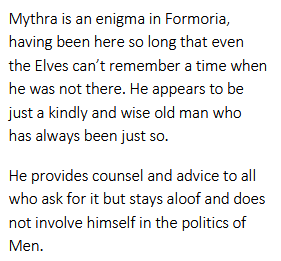
Brilliant, I love it when the book doesn’t tell me what the actual agenda of the powerful movers and shakers of its world are. Mythra could want anything or nothing. He lives in an ivory tower and does not concern himself with the affairs of the world. Mythra is the 1%. Maybe he’s Elminster, just without the copious amount of pseudo-incestual grooming. Maybe Mythra is three goblins in a robe and pointed hat and they’ve been playing the whole of Formoria for suckers for years.
Finally, we have four groups of bandits. They do bandit things. They are each specialists in hitting hard, fast, being hard to catch and stacking their lairs with traps and ambushes. What do they want? Bandit things. What are their named members like? Deadly bandits, brilliant tacticians, vicious leaders. Two of their factions, the Forsaken and the Green River Men, often stop at the village of Byrth to dock. This is not mentioned within any of the faction profiles, I had to scroll back to Byrth itself to know that. Neither do I know how the two pirate bands interact when occupying the same vague region and, in fact, are terrorising the same river. Are they allies? Do they tolerate another? Rivals? Arch-enemies? Do they take shifts?
By the way, did you know that the Book of Baahl, that the Knights of Tower Bridge were supposed to safe-keep, is currently in the possession of the Sorceress Batul, by the way? You know how I know this? I had to flip to the very end of the book to find out about it. Would’ve been nice to know about this on the same page as the faction whose whole half reason to exist is circling around the damn thing.
In fact, for a plethora of information important for a GM to keep in mind related to a location or faction or what-not, the task of finding it amounts to a scavenger hunt. This might be fun if I were to do some light reading. It is not fun when a player asks about information regarding something in the setting and you have to put them in time-out for 30 minutes to flip back and forth hundred pages at a time in order to properly find any relevant information. I’m glad for the search function, but it shouldn’t be something I’d have to constantly rely on just for this review alone.
Next come Legendary NPCs, Living Legends, Lords and Ladies. Of the former, each of their in individual profiles is roughly as long, if not longer than some of the realms’ descriptions found earlier. It would have been nice if these Legendary figures were included much earlier, attached to the pages detailing the realms. Same for the living legends, whose life stories are meticulously detailed, but for the most part are levitating in the nebulous areas of just-out-of-reach-but-would-be-very-convenient-if-they-could-solve-the-plot. The actual lords and ladies seem like an afterthought. Most of them, too, lack any sort of goals and secrets. Plenty of biography though. I still don’t find what Mythra actually wants to do beside smoke weed and be aloof all day. While I envy the lifestyle, some form of direction would be nice.
Zahdikaar, Lich King of Vaadmor even receives some pretty baller artwork. Undeath may have stripped his skin to the bone, but damn if he doesn't have some luscious locks. What’s he up to, these days? I dunno, moulding under his crypt in Vaadmor. Is anybody trying to free him? Well, the forces of light made sure to seal him away so good none of the Shadow found a way yet. So, I dunno. Maybe? The Knights of the White Order are always staring his direction. There is not much in the way of fruitful voids to fill in this book. Some NPCs are mentioned to have absconded with powerful items. No clue why or where they are, half of them are dead.
PART V: MONSTERS; RANDOM ENCOUNTERS, TREASURES, CITATIONS NEEDED
Bestiaries, treasures and random encounters are one of those aspects of writing and designing a setting that really allow you to flex our creative muscles. I wish some of those had been mildly warmed up here, at least.
The monsters found here are, at best, just slight rehashes of the ones already present in the Shadowdark Core Rulebook, with some having maybe one additional or changed talent and inconsistent HP values. Monster stats also tend to break across the page, making them a hassle to read more often than not. Notably, none of the living legends mentioned in the previous part have any statblocks. Would’ve been nice to have, especially for that big bad lich king that has a whole double-spread dedicated to him.
The Random Encounter Tables each have a page blurb added that give a brief overview of the region they are attached to, which I do appreciate, and are uniquely divided into day and night encounters, which I think is very neat, but are ultimately just a list of monsters, rather than anything substantial. One of the joys of Random Encounters in the Overworld is them functioning as little scenarios for the PCs to stumble across that can help make the travel feel more alive and also build out the world – here, it is clear they merely function as a combat encounter, at best.
In the Magic Item section, we are hit with more lore: individual magic item descriptions are not structured according to the Bonus, Benefit and/or Curse structure that is codified in the SD Core Rules, but are usually a column and a half of historical background mixed with the actual benefits and/or drawbacks of the item. I realise this is done to fulfil the book’s own ethos of making each individual magic treasure seem huge, important and with a history of its own, but I found it difficult to parse most of the time. There is a +2 shield that receives more attention than some of the faction leaders.
PART VI: HISTORIAE ASTERRA (AKA WE HAVE THE SILMARILLION AT HOME)
More lore, everybody. This time, we’re getting the history of the entire world, I guess7 and I am honestly not too sure how to proceed here without sounding like I am taking a metaphorical dump over the author’s twenty year long game. It spans 23 double-column pages, including a 4 page interlude depicting a historical battle and grants a general overview over the history of the world of Asterra from its genesis to the present - most of it presented as a list of armed conflicts. And I mean a lot of armed conflicts.
It is also, mostly, the standard fantasy setting backstory that followed in the wake of Lord of the Rings and Greyhawk, down to the Orc God Not-Gruumsh-but-Kain getting one of his eyes poked out by the Elven God Not-Corellon-But-Korelin. It’s not an exact copy, but you’ll quickly see the standard patterns cropping, with some Ancient Greek Myth, Tolkien-esque tropes and some dualism thrown in for small measure:
In the beginning, there was a Void, until a great All-Maker came who created the firmaments and a world-mother, Aeverra, who gave form to the universe. Then along came three brothers, who approached Aeverra with gifts to shape and make her more beautiful, thereby creating the material world. They then copulate with her⁹, make more gods, of which there are an exact number of good and evil (sorry, Light and Shadow-aligned) gods, and assign each of them their realms, with the gods predisposed to Light getting the yachts and real estates, and the gods pre-disposed toward Shadow receiving trace acknowledgement of existing and a trash-heap to wallow in. The Gods of Shadow, Murder, Destruction, Candy-Stealing and Dog-Kicking get angry, and swear to muck up the entire playground in retaliation.
Afterwards, war time. Many wars. The entire first age is dedicated to elves doing stuff. Afterwards the Rise of Man. I am reminded of the Silmarillion, but not in a fond manner, as I would be otherwise. After the ninth expansion or war fought, I find my eyes glazing over.
I experienced Deja-Vu multiple times as my eyes glazed across the chronicles, stumbling as I swore I had read passages and entire pages already presented earlier in the book, just worded differently. I lose myself in terse descriptions of ten-thousands, hundred-thousands of elves and humans dying against orcs and undead. There are tidbits of information that would have been useful to know back in the Realms pages. I reach the end. I am free. I look back at what I had read and realise I have not retained a single damn thing from it. The history of Asterra is war unending and it does not have the benefit of being somewhat amusing like Warhammer. It’s just statistics. And Greyhawk.
PART VII: ADVENTURE – TROUBLE IN LOVILLE (AKA WELCOME TO THE RAILROAD)
Trouble in Loville is meant to be an introductory adventure for the Formoria Setting. It’s hook is fairly straightforward: a small woodcutter’s village is haunted by a ghost, sighted wandering the fringes of the woods. The PCs are asked to investigate.
The adventure begins with a brief overview of the village of Loville and the problem they are facing: a ghostly apparition is roaming the nearby woods and the superstitious villagers are frightened to go inside the wood, the local priest is inept at banishing said apparition and the local lord is starting to get fidgety about not receiving his wood. Someone must deal with this and that someone is the players.
The hook itself provides a decent amount of intrigue and Loville itself is set-up well enough for a GM to use. Its not a large village by any means, but you got a central longhouse to gather your NPCs in, the Earl Chlodomer to serve as your main expositor, a blacksmith that the PCs can hire for some extra muscle and a gaggle of woodcutters to form the chittering, superstitious masses to regale the PCs with horror stories of the apparition. You also have a small table for male and female NPC names for a GM to fall back on, which is a nice addition.
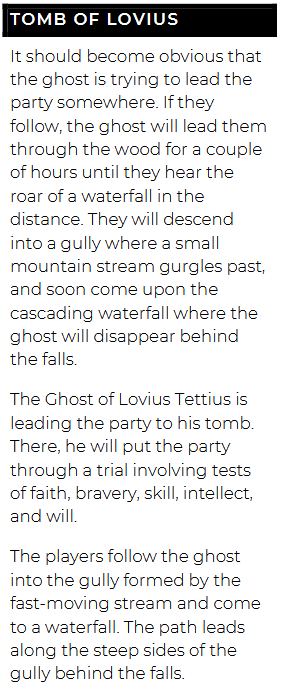
All the NPCs will point the PCs toward the wood itself, where the apparition will appear as a shadowy presence, beckoning the party deeper into the woods. If they choose to follow, the ghost will lead them toward the actual adventure location, if they don’t, the apparition will stare at them until they feel very uncomfortable.
Alright. Time for the dungeon. It consists of 5 rooms, each of which is supposed to test the characters.
Area 01: Tunnel Stair. A green ooze hangs on the ceiling to drop on an unsuspecting party. The only way to not see it is by not looking up. Even then, there is a 1:6 chance the party can still just notice and walk around it without it as much as moving. Even if it snatches a party member, its statblock gives them 6 whole rounds before it even begins dissolving its victim, with another 1d4 rounds before its prey is turned into another Green Slime. It also moves at a close distance and though it can only be harmed by cold and fire, there is nothing stopping a party from just pulling a party member out of it and strolling away. Did I also mention it has a 0 AC, as in, you can only miss on a Natural 1 and it has only 9 HP?
Area 02: Tomb Entrance. A sealed door with a carving with a kneeling Centurion in front of a great Eagle. Beneath is an inscription saying “Only the Faithful May Pass”. Skeletons lie all over. The solution here is for the party to kneel and pray to any of the Neutral or Light Gods they know and the door will open. They’ll also have to contest with six skeletons, who are all LV 1 and rise in pairs every round. Players who cannot read the language or fail to kneel can also just cast the knock spell or brute-force their way past the door with pickaxes. Strangely, the latter two options do not induce an automatic fail-state, since this is supposed to be a test of faith. Maybe faith in my own brawn and brain counts. The skeletons will not give chase if the party retreats. No mention if they chase if the party proceeds.
Area 03: Hall of Sacrifice. Four wall-carvings depicting scenes of Lovius’ life, each showing a sacrifice he made of Blood, Sweat, Tears and Coin. Four bowls are set beneath the wall-carvings. There is no other threat in this room and, unless the skeletons from the last area count, the only real danger here is the players maybe getting stuck on the carving depicting Lovius training. If each bowl is filled with the appropriate sacrifice, the passage opens into Area 04. Again, unless the skeletons are still "alive", for lack of a better term, there is no real danger or pressure on the PCs here.
Area 04: Hall of Judgement. A hall of stone soldiers with puckered lips, as if blowing out a torch. The big danger here is a 3d10 damage fire trap that fills out the room if the pressure plate is not found. Otherwise, its practically an instant-death.
The issue is, the party will automatically find the pressure plate. Unless there is time pressure. Then they have to make a DC 10 DEX check to find it. What time pressure? The torch? The skeletons? The Ooze, crawling at a snail’s pace way behind? Even if they fail to find it, they can still jump over it with a DC 10 DEX check. Or automatically, if they already know it is there.
Area 05: Tomb of Lovius. Behold, the ghost returns, standing in front of his own sarcophagus. He approaches the party. If they attack him, he likely kills them because he is a LV 6 undead who is immune to non-magical damage. Instead, they are supposed to let him possess one of the party members and then give a dramatic ending monologue.
The adventure ends with the ghost patting our heroes on the head for bravely walking through the corridor of mild inconvenience, handing out one treasure from a select choice, and then informing them of an evil cult doing the shagnasty in the town of Forkdale, with them being the reason for his haunting. The actual adventure tied to that particular event, is not presented in the book - nor is there any evil mentioned way, waaaaaaaaaay back on Forkdale’s page description. Would’ve been nice to see a mention of that to naturally link to this adventure.
I fully realize that this meant to be a starting adventure and 5-room dungeons are a popular enough way of designing one, but when your adventure is little more than a snail-shaped corridor with about the same pace as an actual snail, I’d probably charge the ghost at the end out of spite. The only real brain-teaser or tension-causing moment may be the last area, where you have to let the ghost possess one of the party members. Two out of four threats can literally be avoided by just spending one action to either look up at the ceiling or searching the area. The only real threat are the ghost, and maybe the skeletons - but they are set to only rise in pairs of two, and only in staggered fashion. There is nothing stopping a party from just ganging up on them. They only have 5 HP and AC 10. The players will likely number four, on average. This is little more than a walking simulator. There isn’t even any other treasure aside from the choice a party makes at the end. They gain 3 XP from this.
PART VIII: CONCLUSION & SUGGESTIONS FOR IMPROVEMENT
My problems with Formoria: The Dark Age are manifold when it comes to the usage of the setting at a table.
We are flooded with the lore and history, but left with a dearth when it comes to actual hooks for present adventures, and the few that are given are hard to find.
We are given factions but little in the way or reason to join them, relegating them mostly to a background element. There is only one moment that two factions are explicitly mentioned to interact with one another in the entire book in some form of conflict.
We are hounded with detailed founding histories and aesthetics of several towns and cities, yet I am at a loss at what is actually going on in them at this moment.
We are presented with a vast cast of NPCs to fill the setting with, yet I am left scratching my head over what it is these movers and shakers of Formoria actually want and why ever they would even cross the paths of the PCs.
A lot of effort went into giving this world a history and important events that happened in its past, yet the present feels largely empty. There is absurd width, but it is ultimately shallow. For all the claim that it is inspired by the 4th century dark age, what I find is by and large mostly just what I’d find opening up Greyhawk or Forgotten Realms.
There are people who enjoy the Silmarillion as light reading for recreation and relaxation (I should know, I am one of them), there are people who want only the barest bones and room for their own spin on the framework presented. There are people who look for a unique world and take on standard fantasy tropes, and there are people who will happily play the same Standard European Fantasy analogue with swordsmen, elves, elf-hating dwarves and evil dark lords in towers and be absolutely contended with their evening. I know and understand the appeal behind both. I am also, unashamedly, in the former camp and admit my bias to that.
But regardless of personal taste, Formoria, as it is now, does not prove serviceable when it comes to its actual, primary purpose as a tool for a GM. Relevant information is scattered, rather than delivered ad-hoc and where it should be relevant. Most of the interesting things were already accomplished and legendary deeds already fulfilled by long-dead NPCs. Beyond knowing that a ton of wars happened, I couldn’t tell you anything about what the world of Asterra uniquely feels like.
Its strict adherence to standard fantasy and especially OD&D-codified tropes will probably allow you to place practically any adventure you can imagine into it without much of an issue, but you’ll be left with a lot of homework trying to extract practical, for-use-at-the-table information, because most of it is scattered in anecdotes of various wars or tucked in the very back of the book, making paging through it and looking for that specific piece of information an absolute hassle. But if that is all that the setting feels “good” for after reading through it, you might as well just roll it up yourself with a bunch of tables or just run Greyhawk.
Here’s some things I would suggest to make it so:
Factions. Give them an actual, long-term goal to pursue and reasons to oppose or align themselves with a bunch of murderous vagrants. Bandits want loot and evade the law, sure, but is there anything in particular they are looking to rob from another faction? How do they actually interact with other bandits and brigand factions mentioned? You have the Knights of Temple Bridge detailed down to their favourite 11-am tea break biscuit, but what long-term goal are they and the city of Temple Bridge which they represent and, basically, lead, actually pursuing at this moment? And it can’t be just preserving the Status Quo, because that would imply someone else is actually pushing to change that within the city of Temple Bridge. Are they doing anything to reclaim the Evil Book of Supreme Evil? Are they, in fact, providing any sort of hook for players?
Also, assign them to their proper locations in the book. Sure, you won’t have a separate Factions & Organizations section this way, but what you’ve just made the job of any GM reading your setting guide easier - and with only five semi-relevant factions so far (and no, I am not counting bandits as factions yet, they are obstacles at best), it doesn't exactly warrant
NPCs: Give each NPC a goal and a secret, in plain words and, rather than gathering all 50+ of them in the back of the book, assign them properly to each location/realm they can be found in. It’ll make it easier for both the GM trying to breath life into your meticulously detailed cities and kingdoms.
Regional and Location Hooks: Put down one to three potential hooks, conflicts or secrets for each city, town, village or just general location for the GM to riff off of. It was done fairly well with Trouble in Lorule, despite the attached dungeon being rather lacklustre.
Rework Shadow and Light – Alignment System. Give some concrete consequences of what happens to a character or party that falls to the Shadow, especially if you describe your alternative alignment system with the words of ‘Spiritual HP’. Does the character become a monster and is retired from play? Do certain gods or beings deny boons? Do others become available to them? What is the actual concern faced by the characters as they fall to Shadow?
Rework Bestiary & Magic Items: With the 4th century, dark age inspiration, there is potential here for more than just the standard monsters: Formorian forager troops or orc riders, Bhaal-blessed minotaurs, Northman raiders or Imperial Elf Warriors, hell, detachments of barbarian auxiliaries or mercenaries.. You have a lot of living legends, you have the knight orders, you have the rangers and orc tribes and bhaalspawn. Come up with some additional representatives of all these beings you have.
If you are only going to use the monsters already present in standard Shadowdark with little to no alteration, you might as well cut the bestiary entirely.
For the treasures magic and legendary, apply the Shadowdark standard. Description, Bonus, Benefit, Curse if necessary. Don’t mix description and bonuses together.
Rework Random Encounter Tables: Write a little blurb for what the monsters are doing when you encounter them in the wilds. 2d4 wolves on its own does not make for an exciting encounter, and with a dark ages inspired world, there are a boundless amount of scenarios for a party to stumble upon in any section of the world.
Rework Village of Loville: The hook of investigating a ghost-sighting leading to a test of the heroes’ strength, guile and pluck, leading to the revelations of a greater evil lurking in one of the major towns is honestly a great one - but we need some well done meat on these bones and a lot less hand-holding. And, maybe, the actual adventure in Forkdale, too. As it stands, Loville feels more like a prelude to an actual adventure I’d expect to find in a book this large.
That's all I have for today.
https://www.drivethrurpg.com/en/product/485723/formoria-the-dark-age
1 Not to mention, the shelves of their collectors. Do we sort alphabetically, by game, genre or format? Drives you mad.
2 Setting As Written. I am sure you can also turn most settings into a Saw-esque gorefest, if you really want to. Even the bright and innocent ones. It seems to be all the rage with works hitting the Public Domain nowadays.
3 I.e.: personal fetishes disguised as core cultural foundations, Philosophy 101 starter quandaries and a nostalgia for media and cultural perceptions from a time roughly two decades before the author chose to start putting words on paper.
4 An important facet to keep in mind to prevent your world and game from becoming torture porn – also known as the average Vampire: The Masquerade session with a Tzimisce player present.
5 Then again, imagine a ranger class modeled after Crocodile Dundee, instead. Get on it, designers.
6 Damn pointy-ears.
7 Just without the advertisement jingle-whimsy of Bill Wurtz.
8 Because the damn bastard shows up inexplicably multiple different times throughout the later history to do something spectacular in typical wizard fashion.
9 I imagine they took turns. At least, I hope they did. And that the All-Maker wasn’t sitting by and watching.Then again, can a supreme god even not be aware of such things happening right under his nose? Imagine being constantly aware of all the ants on your lawn fornicating. Horrifying.
10 Kain had clearly read the peer-reviewed and often cited treaties of Melkor and Curomo, and exchanged notes with the late lord and owner of Barad-Dur concerning “proper” treatment of his orc hordes.
11 The optimist in me wants to believe it is by and large a reference to the Minoan Civilization, who were mysterious and ancient even to people of Classical Greece, and were known to them as a seafaring people. But that would mean that this “lowest” caste of minotaurs should really stand at the pinnacle of their people. But, Blood for the Blood God and what not.


